What Is Obsessive-Compulsive Disorder?
Obsessive-Compulsive Disorder (OCD) is a mental health condition involving
We do not aim to eliminate intrusive thoughts (everyone has them). Instead, treatment helps you learn how to respond differently to doubt and stop compulsions from controlling your life.
We offer evidence-based treatment for OCD — including Exposure and Response Prevention (ERP), CBT, ACT, and Inference-Based CBT (IB-CBT) — for children, teens, and adults.
OCD Cycle
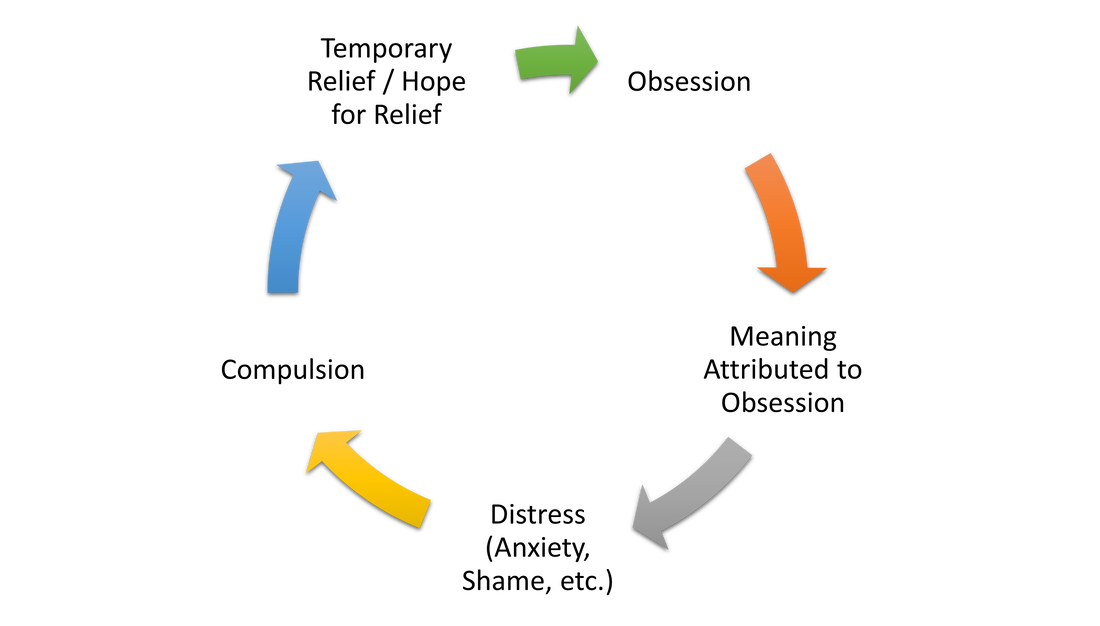
If left untreated, OCD symptoms tend to worsen over time. This is because OCD involves a repeating cycle in which people feel compelled to engage in repetitive behaviours or mental acts (compulsions) in response to unwanted, intrusive thoughts or images (obsessions). Although compulsions may provide temporary relief — or the hope of relief — they often interfere with daily activities, relationships, and the things people value most. Because the relief is only temporary, the obsessions and distress return, and the cycle begins again.
Understanding this cycle can help make sense of why OCD feels so powerful and why treatment is so effective. The cycle typically involves four main parts:
1. Obsession: An intrusive thought, image, or urge appears suddenly.
2. Assigning Meaning or Importance: The intrusion is interpreted as significant, dangerous, immoral, or revealing (“What does it mean that I had this thought?”). This step is central to OCD. The thought begins to feel urgent or threatening, even if the situation is harmless.
3. Anxiety or Discomfort: The obsession creates distress — such as fear, guilt, shame, uncertainty, or a strong sense of responsibility.
4. Compulsion: A behaviour or mental act is performed in an effort reduce distress or prevent something bad from happening. This may include checking, washing, re-doing, avoiding, reassurance seeking, mental reviewing, or other rituals.
5. Temporary Relief → Cycle Strengthens: Compulsions provide brief relief, but they reinforce the fear and make the obsession seem meaningful or dangerous. Over time, the urge to perform compulsions becomes stronger, and OCD takes up more space in a person’s life.
The diagram below provides a visual representation of the OCD cycle.
- Obsessions: unwanted, intrusive and distressing thoughts, images, or urges
- Compulsions: behaviors or thinking patterns performed to reduce distress, but over time, they make OCD stronger.
We do not aim to eliminate intrusive thoughts (everyone has them). Instead, treatment helps you learn how to respond differently to doubt and stop compulsions from controlling your life.
We offer evidence-based treatment for OCD — including Exposure and Response Prevention (ERP), CBT, ACT, and Inference-Based CBT (IB-CBT) — for children, teens, and adults.
OCD Cycle
If left untreated, OCD symptoms tend to worsen over time. This is because OCD involves a repeating cycle in which people feel compelled to engage in repetitive behaviours or mental acts (compulsions) in response to unwanted, intrusive thoughts or images (obsessions). Although compulsions may provide temporary relief — or the hope of relief — they often interfere with daily activities, relationships, and the things people value most. Because the relief is only temporary, the obsessions and distress return, and the cycle begins again.
Understanding this cycle can help make sense of why OCD feels so powerful and why treatment is so effective. The cycle typically involves four main parts:
1. Obsession: An intrusive thought, image, or urge appears suddenly.
2. Assigning Meaning or Importance: The intrusion is interpreted as significant, dangerous, immoral, or revealing (“What does it mean that I had this thought?”). This step is central to OCD. The thought begins to feel urgent or threatening, even if the situation is harmless.
3. Anxiety or Discomfort: The obsession creates distress — such as fear, guilt, shame, uncertainty, or a strong sense of responsibility.
4. Compulsion: A behaviour or mental act is performed in an effort reduce distress or prevent something bad from happening. This may include checking, washing, re-doing, avoiding, reassurance seeking, mental reviewing, or other rituals.
5. Temporary Relief → Cycle Strengthens: Compulsions provide brief relief, but they reinforce the fear and make the obsession seem meaningful or dangerous. Over time, the urge to perform compulsions becomes stronger, and OCD takes up more space in a person’s life.
The diagram below provides a visual representation of the OCD cycle.
What Are the Symptoms of OCD?
OCD can look very different from one person to another. While TV and movies often focus on handwashing, cleaning, or checking, these are only a few possible presentations. OCD includes many different themes, and even within a theme, symptoms can vary widely. Two people with the same theme may have completely different fears, triggers, or compulsions.
Because of this, there is no single “type” of OCD. What matters most is the pattern:
Physiological & Emotional Symptoms: These symptoms arise when one experiences intrusive thoughts or doubts.
Thinking Symptoms: OCD is often called a disorder of doubt, because uncertainty feels threatening, dangerous, or intolerable. At the core of OCD is experiencing uncertainty about a specific topic as something that must be resolved immediately, rather than something that can be tolerated. People may experience:
The presence of intrusive thoughts does not mean anything about a person’s character or intentions.
Behavioural Symptoms: Compulsions are any actions—visible or internal—used to reduce distress or prevent feared outcomes. Behaviours may include:
Important Note on Variability: OCD symptoms are highly individualized:
Because of this, there is no single “type” of OCD. What matters most is the pattern:
- An intrusive thought, image, or feeling creates distress
- This thought is given meaning or significance
- Anxiety or guilt rises
- A compulsion (behavior or mental act) is performed to reduce distress
- Relief is temporary, and the cycle continues
Physiological & Emotional Symptoms: These symptoms arise when one experiences intrusive thoughts or doubts.
- Sudden waves of anxiety or discomfort
- Feelings of guilt, shame, or intense responsibility
- “Not-right” sensations or internal tension
- Emotional exhaustion
- Heightened distress when resisting compulsions
Thinking Symptoms: OCD is often called a disorder of doubt, because uncertainty feels threatening, dangerous, or intolerable. At the core of OCD is experiencing uncertainty about a specific topic as something that must be resolved immediately, rather than something that can be tolerated. People may experience:
- Intrusive, unwanted thoughts or images
- Fear of causing harm, illness, or moral wrongdoing
- Doubts about memory, intentions, or identity
- “What if…?” spirals that feel impossible to shut off
- Mental reviewing, analyzing, or debating with the thought
- Perfectionistic or “just right” thinking
- Overestimating danger or personal responsibility
- Feeling that they must find certainty, even when it is impossible
The presence of intrusive thoughts does not mean anything about a person’s character or intentions.
Behavioural Symptoms: Compulsions are any actions—visible or internal—used to reduce distress or prevent feared outcomes. Behaviours may include:
- Repetitive checking or asking for reassurance
- Avoiding certain objects, tasks, or situations
- Repeating actions until they feel “right”
- Washing or cleaning routines
- Mental compulsions (praying, counting, reviewing, replaying conversations)
- Confessing to others out of fear of wrongdoing
- Researching, googling, or seeking certainty
- Excessive rule-following or self-monitoring
- Rumination: excessive analyzing, problem-solving, or self-reassurance done to reduce anxiety.
Important Note on Variability: OCD symptoms are highly individualized:
- Two people with contamination fears may have completely different triggers
- One person’s compulsions may be physical; another’s may be entirely mental
- Some themes involve no visible compulsions at all and mainly involve rumination
- OCD can shift themes over time—or involve multiple themes at once
-
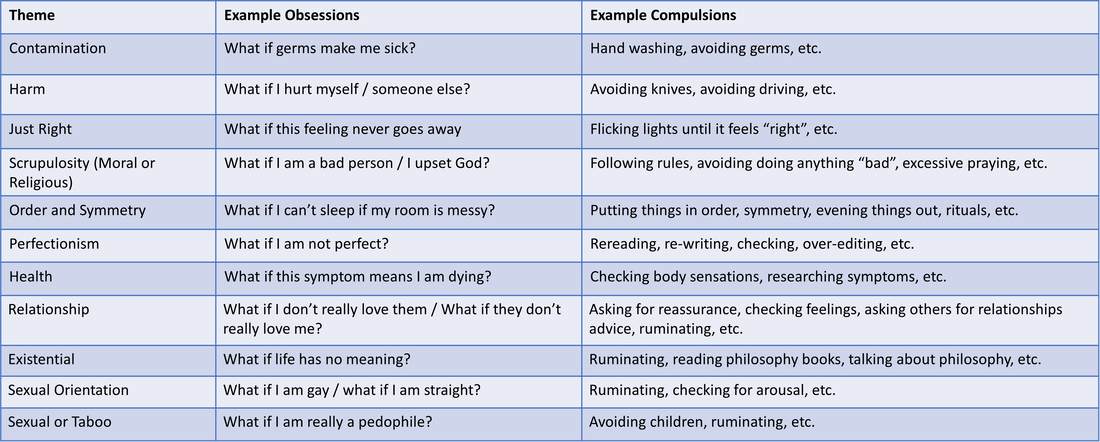
What are the Different Themes of OCD?
OCD can show up in many ways. The theme may shift over time, but the pattern remains the same: intrusive fear → anxiety → compulsion → temporary relief.
Theme |
Description |
Obsessions (Examples) |
Compulsions (Examples) |
Contamination |
Fear of germs, illness, chemicals, or contamination. |
What if I get sick from touching this? |
Excessive washing, cleaning, or avoidance. |
Harm |
Fear of accidentally or intentionally harming oneself or others. Often involves intrusive images. |
What if I hurt myself/someone else? |
Reassurance seeking, or avoiding knives, driving, etc. |
Symmetry/ "Just Right" |
A need for things to feel perfect, balanced, or “correct.” |
What if this feeling lasts forever? |
Arranging, repeating, evening out, or re-doing. |
Scrupulosity (Moral or Religious) |
Fear of being immoral, sinful, dishonest, or unethical. |
What if I am a bad person/upset God? |
Mental checking, confession, or reassurance-seeking. |
Relationship |
Intrusive doubts about one’s feelings, partner, or whether the relationship is “right.” |
What if I don't really my partner? |
Reassurance seeking, mental reviewing, comparing, checking feelings. |
Sexual Orientation |
Intrusive worries about identifying with a sexual orientation that does not truly represent them. |
What if my sexual orientation isn’t what I think it is, and I end up hurting my partner or making the wrong choices? |
Checking arousal sensation, seeking reassurance, researching. |
Sexual or Taboo |
Intrusive, unwanted thoughts, images, or urges about topics that feel upsetting, inappropriate, or against the person’s values |
What if having this thought means something about me, even though I don’t want it and it feels completely wrong? |
Mental reviewing, avoiding people or situations, trying to “neutralize” thoughts, repeating actions to feel “safe”. |
Health / Somatic |
Intrusive worries about having or developing a serious illness, even when there is little or no evidence. |
What if this sensation means something serious? |
Body checking, online searching, seeking reassurance, monitoring symptoms. |
Perfectionism |
Intrusive fears about making mistakes, not getting things “right”. |
What if this isn’t good enough? |
re-checking work, re-doing tasks, excessive organizing, over-preparing, seeking reassurance, avoiding tasks for fear of making mistakes. |
Existential |
Worries about reality, identity, or the meaning of life that feel impossible to resolve. |
What if Ilife has no meaning? |
Overthinking, researching, reassurance seeking, checking for a sense of “realness.” |
Frequently Asked Questions About Anxiety
Is OCD Normal or Is Something Wrong With Me?
Intrusive thoughts are normal — everyone has them.
OCD becomes a concern when these thoughts feel threatening, uncontrollable, or lead to compulsions that interfere with daily life.
Many people with OCD believe they are alone or that no one else has thoughts like theirs. You may not have met others with OCD, but we work with people every day who experience similar fears, doubts, and intrusive thoughts. OCD is far more common than most people realize, even though many suffer in silence.
We also want you to know: Nothing you say will shock us.
We’ve truly heard everything in sessions — every theme, every thought, every fear. Our approach is open, non-judgmental, and grounded in compassion and evidence-based care.
You are not alone — and OCD is a well-researched, highly treatable condition. With treatment, intrusive thoughts lose their power, compulsions decrease, and life becomes much less restricted.
OCD becomes a concern when these thoughts feel threatening, uncontrollable, or lead to compulsions that interfere with daily life.
Many people with OCD believe they are alone or that no one else has thoughts like theirs. You may not have met others with OCD, but we work with people every day who experience similar fears, doubts, and intrusive thoughts. OCD is far more common than most people realize, even though many suffer in silence.
We also want you to know: Nothing you say will shock us.
We’ve truly heard everything in sessions — every theme, every thought, every fear. Our approach is open, non-judgmental, and grounded in compassion and evidence-based care.
You are not alone — and OCD is a well-researched, highly treatable condition. With treatment, intrusive thoughts lose their power, compulsions decrease, and life becomes much less restricted.
What’s the Difference Between Normal Doubt and OCD Doubt?
Normal doubt is occasional, flexible, proportionate, and usually easy to resolve. You might double-check something once or think it through briefly, and then the doubt naturally fades.
OCD doubt feels very different.
In OCD, doubt becomes persistent, intense, and hard to move past. It often feels like something important is at stake — even if the situation is minor or unlikely. Early on, compulsions may seem to “fix” the doubt or bring temporary relief. But over time, relief becomes shorter, the doubt returns more quickly, and the urge to check, avoid, or mentally review grows stronger.
OCD doubt tends to feel:
The core difference is this:
OCD doubt keeps asking for certainty — even when certainty isn’t possible. No one can know with absolute certainty that they are a perfect person, that they love someone, that they will never make a mistake, or that every action is morally flawless. Life involves uncertainty, but OCD convinces people that perfect certainty should be possible — and that they must keep doing certain behaviours until they achieve it. This is what keeps the OCD cycle going.
The good news is that OCD is highly treatable. With ERP or ACT, people learn to tolerate uncertainty, reduce compulsions, and weaken the doubt cycle over time.
OCD doubt feels very different.
In OCD, doubt becomes persistent, intense, and hard to move past. It often feels like something important is at stake — even if the situation is minor or unlikely. Early on, compulsions may seem to “fix” the doubt or bring temporary relief. But over time, relief becomes shorter, the doubt returns more quickly, and the urge to check, avoid, or mentally review grows stronger.
OCD doubt tends to feel:
- Sticky — it lingers even when you try to dismiss it
- Urgent — it feels like you must figure it out right now
- Repetitive — the same doubt comes back over and over
- Impossible to satisfy — eventually, no amount of checking feels “enough”
The core difference is this:
OCD doubt keeps asking for certainty — even when certainty isn’t possible. No one can know with absolute certainty that they are a perfect person, that they love someone, that they will never make a mistake, or that every action is morally flawless. Life involves uncertainty, but OCD convinces people that perfect certainty should be possible — and that they must keep doing certain behaviours until they achieve it. This is what keeps the OCD cycle going.
The good news is that OCD is highly treatable. With ERP or ACT, people learn to tolerate uncertainty, reduce compulsions, and weaken the doubt cycle over time.
How Is Anxiety Different From OCD?
Anxiety and OCD are related but not the same. While both involve fear and discomfort, the way thoughts and behaviours show up is different.
Anxiety is a natural response to stress or uncertainty. It often includes:
OCD involves intrusive, unwanted thoughts or images (obsessions) that create distress, followed by compulsions—actions or mental rituals meant to feel safer or more certain.
Examples:
Key Differences
Both are treatable, and some people experience both. Therapy helps reduce avoidance and compulsions and supports new, more flexible ways of responding to distressing thoughts.
Anxiety is a natural response to stress or uncertainty. It often includes:
- worry about everyday life problems (school, work, relationships, health)
- physical symptoms like tension, restlessness, or a racing heart
- feeling overwhelmed during stressful situations
- wanting to avoid things that feel frightening
OCD involves intrusive, unwanted thoughts or images (obsessions) that create distress, followed by compulsions—actions or mental rituals meant to feel safer or more certain.
Examples:
- “What if I contaminated someone?” → washing
- “What if I cause harm without meaning to?” → checking
- “What if this food isn’t cooked enough?” → reassurance seeking
- “What if it’s not exactly right?” → arranging or re-doing
Key Differences
- Intrusive thoughts:
- Anxiety: worries are usually about realistic concerns.
- OCD: thoughts are intrusive, unwanted, and often feel out of character.
- Behaviour:
- Anxiety: people avoid discomfort.
- OCD: people perform compulsions to reduce distress or gain certainty.
- Doubt:
- Anxiety: doubt is stressful but temporary.
- OCD: doubt feels urgent, sticky, and very hard to resolve.
- What maintains symptoms:
- Anxiety: avoidance and worry loops.
- OCD: compulsions and reassurance seeking.
Both are treatable, and some people experience both. Therapy helps reduce avoidance and compulsions and supports new, more flexible ways of responding to distressing thoughts.
What Causes OCD?
There is no single cause of OCD. Research shows that OCD develops from a combination of biological, genetic, temperamental, and environmental factors. Not everyone is equally vulnerable — some people have a stronger natural sensitivity to uncertainty, responsibility, or threat.
Key contributors include:
These factors create vulnerability. OCD is not caused by parenting, personality flaws, or a specific life event.
Factors That Exacerbate or Maintain OCD Symptoms
These factors do not cause OCD, but they can trigger symptoms in vulnerable individuals or intensify existing symptoms:
The important thing to know is that OCD is highly treatable. With the right support, people can learn to break the cycle, and OCD becomes much more manageable.
Key contributors include:
- Biological factors: differences in how the brain processes threat, doubt, and uncertainty
- Genetics: OCD and related anxiety conditions often run in families
- Temperament: traits such as perfectionism, high responsibility, and intolerance of uncertainty
These factors create vulnerability. OCD is not caused by parenting, personality flaws, or a specific life event.
Factors That Exacerbate or Maintain OCD Symptoms
These factors do not cause OCD, but they can trigger symptoms in vulnerable individuals or intensify existing symptoms:
- Stress, transitions, and lack of sleep: symptoms often worsen during major life changes, high stress, or when sleep is disrupted
- Compulsions and avoidance: these provide short-term relief but unintentionally reinforce the OCD cycle over time
The important thing to know is that OCD is highly treatable. With the right support, people can learn to break the cycle, and OCD becomes much more manageable.
Can OCD Cause Physical Symptoms?
Yes. The anxiety created by intrusive thoughts can trigger physical symptoms. These sensations come from the stress and distress caused by intrusive thoughts and the pressure to neutralize them—not from OCD directly affecting the body.
People with OCD may notice:
These symptoms come from the mental effort involved in managing intrusive thoughts, resisting compulsions, or performing rituals. OCD can be mentally demanding, and that mental strain often shows up physically.
If physical symptoms appear suddenly, are severe, or are new, it’s always appropriate to rule out medical causes. But when physical discomfort accompanies intrusive thoughts, compulsions, or mental rituals, it often reflects the natural stress and strain of OCD—not a physical danger.
With evidence-based treatment (ERP, CBT, ACT), people typically notice both OCD symptoms and physical symptoms decrease as daily life becomes less dominated by compulsions and doubt.
People with OCD may notice:
- tension or tightness
- restlessness or irritability
- fatigue or feeling “worn out” from mental effort
- stomach discomfort
- headaches
- difficulty relaxing
- tension or anticipatory discomfort linked to feared situations
These symptoms come from the mental effort involved in managing intrusive thoughts, resisting compulsions, or performing rituals. OCD can be mentally demanding, and that mental strain often shows up physically.
If physical symptoms appear suddenly, are severe, or are new, it’s always appropriate to rule out medical causes. But when physical discomfort accompanies intrusive thoughts, compulsions, or mental rituals, it often reflects the natural stress and strain of OCD—not a physical danger.
With evidence-based treatment (ERP, CBT, ACT), people typically notice both OCD symptoms and physical symptoms decrease as daily life becomes less dominated by compulsions and doubt.
When Should I Seek Professional Help for OCD?
You do not need to wait until symptoms become severe to reach out for support. In fact, early treatment is far more effective. The longer compulsions and avoidance continue, the more they reinforce the OCD cycle and the harder the patterns can be to break later on. Getting help early can prevent symptoms from growing and can make treatment faster, smoother, and more effective.
People often seek help when they notice things such as:
And of course, support is also helpful when symptoms become more noticeable, such as:
Many people wait months or years before seeking help, often because they feel embarrassed, uncertain, or hopeful that symptoms will go away on their own. But OCD rarely improves without treatment — and early intervention leads to the best outcomes.
Reaching out sooner is a proactive step toward getting relief and regaining control.
People often seek help when they notice things such as:
- intrusive thoughts or doubts that feel hard to shake
- starting to use small rituals or mental habits to feel better
- noticing early avoidance of certain situations
- feeling unsure about what thoughts “mean” or why they keep showing up
- increasing time spent thinking, checking, researching, or seeking reassurance
- feeling stuck, confused, or unsure whether something “is OCD”
And of course, support is also helpful when symptoms become more noticeable, such as:
- compulsions feeling difficult to stop
- daily routines becoming disrupted
- growing shame, distress, or fear
- avoidance making life narrower over time
Many people wait months or years before seeking help, often because they feel embarrassed, uncertain, or hopeful that symptoms will go away on their own. But OCD rarely improves without treatment — and early intervention leads to the best outcomes.
Reaching out sooner is a proactive step toward getting relief and regaining control.
How Is OCD Treated?
OCD is highly treatable. The most effective approaches focus on changing how people respond to intrusive thoughts and reducing the need for compulsions. We offer several evidence-based treatments and tailor our approach to each person’s symptoms, age, and goals.
Exposure and Response Prevention (ERP)
ERP, a form of Cognitive Behavioural Therapy (CBT), is the gold-standard treatment for OCD and our primary approach. Through ERP, clients gradually face feared situations, thoughts, or sensations without doing compulsions without engaging in compulsions. Over time, this helps break the OCD cycle, reduce distress over time, and increase flexibility and choice in daily life.
We take a collaborative and supportive approach to ERP, ensuring that the process feels manageable, safe, and meaningful. For children and teens, we incorporate creativity, engagement, and developmentally appropriate strategies.
Cognitive Behavioural Therapy (CBT)
Because ERP and ACT are types of CBT, our work naturally incorporates CBT principles. CBT helps people understand how thoughts, feelings, and behaviours interact, recognize patterns that maintain OCD, and build more flexible ways of responding to intrusive thoughts.
Acceptance and Commitment Therapy (ACT)
ACT is a form of Cognitive Behavioural Therapy that helps people build psychological flexibility and take action based on their values—not their fears. In OCD treatment, ACT can help individuals:
Inference-Based Cognitive Behavioural Therapy (IB-CBT)
IB-CBT is a newer, treatment approach that focuses on how intrusive doubts begin—particularly when people mistake possibility for probability. It helps individuals:
Collaborative Approach
We view therapy as a collaborative process. We take an active role in teaching strategies, practicing skills in session, and supporting clients as they apply these tools between sessions. While we use the most current evidence-based treatments, we also ensure therapy feels supportive, empowering, and—especially for youth—engaging and even fun.
Medication
Medication can be helpful for some individuals with moderate to severe OCD. While we do not provide medication at our clinic, we are happy to collaborate with your physician or psychiatrist if medication becomes part of your treatment plan.
OCD is highly treatable. The most effective approaches focus on changing how people respond to intrusive thoughts and reducing the need for compulsions. We offer several evidence-based treatments and tailor our approach to each person’s symptoms, age, and goals.
Exposure and Response Prevention (ERP)
ERP, a form of Cognitive Behavioural Therapy (CBT), is the gold-standard treatment for OCD and our primary approach. Through ERP, clients gradually face feared situations, thoughts, or sensations without doing compulsions without engaging in compulsions. Over time, this helps break the OCD cycle, reduce distress over time, and increase flexibility and choice in daily life.
We take a collaborative and supportive approach to ERP, ensuring that the process feels manageable, safe, and meaningful. For children and teens, we incorporate creativity, engagement, and developmentally appropriate strategies.
Cognitive Behavioural Therapy (CBT)
Because ERP and ACT are types of CBT, our work naturally incorporates CBT principles. CBT helps people understand how thoughts, feelings, and behaviours interact, recognize patterns that maintain OCD, and build more flexible ways of responding to intrusive thoughts.
Acceptance and Commitment Therapy (ACT)
ACT is a form of Cognitive Behavioural Therapy that helps people build psychological flexibility and take action based on their values—not their fears. In OCD treatment, ACT can help individuals:
- relate to intrusive thoughts with less fear
- practice diffusion (seeing thoughts as thoughts, not truths)
- clarify personal values that guide behaviour
- integrate values into ERP to make the work more meaningful
Inference-Based Cognitive Behavioural Therapy (IB-CBT)
IB-CBT is a newer, treatment approach that focuses on how intrusive doubts begin—particularly when people mistake possibility for probability. It helps individuals:
- understand the inferential reasoning that drives their OCD
- become more aware of their thinking processes (meta-cognition)
- “unhook” from intrusive doubts before compulsions start
Collaborative Approach
We view therapy as a collaborative process. We take an active role in teaching strategies, practicing skills in session, and supporting clients as they apply these tools between sessions. While we use the most current evidence-based treatments, we also ensure therapy feels supportive, empowering, and—especially for youth—engaging and even fun.
Medication
Medication can be helpful for some individuals with moderate to severe OCD. While we do not provide medication at our clinic, we are happy to collaborate with your physician or psychiatrist if medication becomes part of your treatment plan.
Does OCD Ever Go Away?
Many people with OCD experience a significant reduction in symptoms, and for some, OCD goes into full remission. With effective treatment, intrusive thoughts become far less powerful, compulsions fade, and daily life begins to open up again.
For others, some symptoms may linger from time to time — but they typically become mild, manageable, and far less disruptive than before. Most people report that OCD no longer controls their choices once they learn the right tools.
Getting help early makes a meaningful difference. Approaches such as ERP, CBT, and ACT are highly effective and increase the likelihood of achieving strong, lasting improvement.
It’s also normal for OCD to fluctuate during stressful periods. This does not mean someone is “back at the beginning.” Once individuals learn how OCD works and build confidence using their skills, they can recognize early signs, adjust quickly, and prevent symptoms from growing. In this way, even if OCD reappears during difficult moments, people are well-equipped to keep it from regaining a significant foothold.
For others, some symptoms may linger from time to time — but they typically become mild, manageable, and far less disruptive than before. Most people report that OCD no longer controls their choices once they learn the right tools.
Getting help early makes a meaningful difference. Approaches such as ERP, CBT, and ACT are highly effective and increase the likelihood of achieving strong, lasting improvement.
It’s also normal for OCD to fluctuate during stressful periods. This does not mean someone is “back at the beginning.” Once individuals learn how OCD works and build confidence using their skills, they can recognize early signs, adjust quickly, and prevent symptoms from growing. In this way, even if OCD reappears during difficult moments, people are well-equipped to keep it from regaining a significant foothold.
OCD Resources
Anxiety Education & Self-Help Tools
Child & Youth OCD Support
- The International OCD Foundation has a wealth of resources, research, and videos to help you learn more about obsessive compulsive disorder.
- Anxiety Canada provides clear, evidence-based information on OCD, including how obsessions and compulsions work and tools to support treatment.
- CAMH provides evidence-based information on OCD, including symptoms, treatment options, and research updates from Canada’s leading mental health hospital.
- The National Institute of Mental Health offers a clear overview of OCD, including causes, symptoms, and current research into effective treatments.
- Unstuck: is a documentary about six kids living with OCD. It can provide a great deal of hope for children.
Child & Youth OCD Support
- Kids IOCDF is a website that focuses specifically on the topic of pediatric OCD.
- The IOCDF youth site offers information designed for teens and young adults, including real stories, coping tools, and treatment guidance.
- The Child Mind Institute provides accessible, research-informed information about OCD in children and adolescents, including symptoms, treatment, and family support.